Actually it seems great and stylish. All thing is covered other then at the similar way its looks creative & trendy scarves style. I really love this kuwait hijab style. The Kuwaiti hijab design is one of the latest enhancements to current hijab to these days ! It is appropriate for all age groups, even though this hijab style is very popular among the fourteen to thirteen five years old women. The kwuait hijab style is one of the trendy style to wear . Lets check out the latest trend of Hijab in Kuwait.
Thursday, 31 May 2012
First Arab Woman to Become NASA Researcher
NASA has appointed its membership to a Saudi academic Dr. Majdah Aburass, making her the first Arab woman to join its research team of scientists and Muhammad Ibrahim Al-Rashid, was appointed as a member of the regional research team. Abura holds a doctorate degree from the University of Surrey in environmental studies and biotechnology from UK University and specializing in oil pollutions.
“I chose to focus my research on petroleum since it is one of the most important sources of energy in the Kingdom,” she said.
But it was actually a dead bird that caused her to become interested in the environment. “In 2003 the bird flu virus was spreading around the world, and one day I found a dead bird in my garden. I felt that I wanted to know the cause of the bird’s death and whether it posed a danger to humans, so I decided to take it to a scientific laboratory.”
Muhammad Ibrahim al-Rashid, president of NASA affiliate the Gulf American Foundation for Space said that ”it was the result of her continuous work for the environment to solve its problems”.
As for her new role, she said her appointment came as a result of a collaboration with NASA on a project that she hopes will be implemented in the near future. She was the first Saudi lady selected to be an environmental ambassador.
She is also member of many social organizations such as Women’s Committee, King Research Center, Jeddah Governorate Higher, Governorate Urban Observatory Council and National Research Center in Egypt.
Kuwaiti Woman Politician Calls for Men to be Allowed Sex Slaves – Using Non-Muslim Female Prisoners
A Kuwaiti woman who once ran for parliament has called for sex slavery to be legalized – and suggested that non-Muslim prisoners from war-torn countries would make suitable concubines.
Salwa al-Mutairi’s suggestions have provoked anger and disbelief
Salwa al Mutairi argued buying a sex-slave would protect decent, devout and ‘virile’ Kuwaiti men from adultery because buying an imported sex partner would be tantamount to marriage.
And she even had an idea of where to ‘purchase’ these sex-slaves – browsing through female prisoners of war in other countries.
The political activist and TV host even suggested that it would be a better life for women in warring countries as the might die of starvation.
Mutairi claimed: ‘There was no shame in it and it is not haram’ (forbidden) under Islamic Sharia law.’
She gave the example of Haroun al-Rashid, an 8th century Muslim leader who ruled over an area covered by modern-day Iran, Iraq and Syria and was rumored to have 2,000 concubines.
Mutairi recommended that offices could be opened to run the sex trade in the same way that recruitment agencies provide housemaids.
She suggested shopping for prisoners of war so as to protect Kuwaiti men from being tempted to commit adultery or being seduced by other women’s beauty.
‘For example, in the Chechnyan war, surely there are female Russian captives,’ she said.
‘So go and buy those and sell them here in Kuwait. Better than to have our men engage in forbidden sexual relations.’
Her unbelievable argument for her plan was that ‘captives’ might ‘just die of hunger over there’.
She insisted, ‘I don’t see any problem in this, no problem at all’.
In an attempt to consider the woman’s feelings in the arrangement, Mutari conceded that the enslaved women, however, should be at least 15.
Mutairi said free women must be married with a contract but with concubines ‘the man just buys her and that’s it. That’s enough to serve as marriage.’
Her remarks, made in a video posted on YouTube last month and carried by newspapers in the Gulf States in recent days, have sparked outrage in cyber-space from fellow Kuwaitis and others in the wider region.
‘Wonder how Salwa al Mutairi would’ve felt if during the occupation (of Kuwait) by Iraqi forces, she was sold as ‘war booty’ as she advocates for Chechen women,’ tweeted Mona Eltahawy.
Another tweeter, Shireen Qudosi, told Mutairi ‘you’re a disgrace to women everywhere’.
For Muna Khan, an editor at the Saudi-owned Al Arabiya television station, the ‘icing on the cake’ of Mutairi’s ‘preposterous views’ was her assertion that her suggestions do not conflict with the tenets of Islam.
Mutairi said that during a recent visit to Mecca, she asked Saudi muftis – Muslim religious scholars – what the Islamic ruling was on owning sex slaves. They are said to have told her that it is not haram.
The ruling was confirmed by ‘specialized people of the faith’ in Kuwait, she claimed.
‘They said, that’s right, the only solution for a decent man who has the means, who is overpowered by desire and who does not want to commit fornication, is to acquire jawari.’ Jawari is the plural of the Arabic term jariya, meaning ‘concubine’ or ‘sex slave’.
One Saudi mufti supposedly told Mutairi: ‘The context must be that of a Muslim nation conquering a non-Muslim nation, so these jawari have to be prisoners of war.’
Concubines, she argued, would suit Muslim men who fear being ‘seduced or tempted into immoral behavior by the beauty of their female servants’.
Wednesday, 23 May 2012
Qatar's first female Olympians on target to make history
Bahiya Al-Hamad is a 19-year-old college student and air-rifle shooter who is about to make history for her country.
When she travels to London to take part in the Olympic Games this summer, she will be part of the first group of Qatari women ever to compete at the Olympics.
Qatar is one of only three countries -- the others are Saudi Arabia and Brunei -- which have never sent female athletes to an Olympics Games. This year, three women will represent Qatar at London 2012. The others are swimmer Nada Arkaji and sprinter Noor al-Malki.
All three women have been given wild cards, but there is still a weight of expectation that is not lost of Al-Hamad.
"It's an accomplishment for every Qatari woman," she said. "I hope I can live up to their expectation."
Training at her shooting club outside Qatar's capital Doha, Al-Hamad added: "Every athlete's dream is to reach the Olympics."
Competing in London in July and August will be a high point in her life as well as a historic moment for Qatar. "I will be very excited to go see the atmosphere there and it will sure be one the most special days of my life," she said.
Qatar's first female Olympians Al-Hamad has won several regional competitions in the 10-meter rifle shooting category, but missed out on automatically qualifying for London 2012 by half a point. She said she was asleep when she received a call to say she had been awarded a wild card.
"I wanted to scream," she said. "I really loved it. I was optimistic, but never expected to reach the Olympics.
"My dream when it comes to shooting is to be the Olympic or world champion."
One of her shooting club colleagues, Ali Rashid al-Mohannadi, 21, Gulf and Arab champion, and a senior engineering student, said he has nothing but respect for Al-Hamad.
"I think women now are better than us," he said. "I'm very happy, because she's a talented shooter. I'm very happy for her, and I hope she does well in the Olympic Games."
However, not everyone in his socially conservative country feel the same.
"I feel men don't realize the idea yet, but it depends," said Al-Hamad. "Some of them are OK with it, some are not. They say 'you're a girl and you shoot?'"
She added: "Before, shooting was only for guys but now it became normal for females to an extent. When they saw women emerging in shooting they became a little bit more accepting."
Also on Inside the Middle East: Iraqi artist inspired by George W Bush shoe thrower
Al-Hamad, who is in her foundation year at Qatar University, is now training two hours a day, five days a week with her Uzbeki coach to be ready to compete alongside the world's greatest 10-meter rifle shooters.
"We participated in the junior Olympic Games in Singapore two years back but the result was not good," said her coach, Ivan Shahov. "But I hope with this Olympic Games we have a chance."
When she travels to London to take part in the Olympic Games this summer, she will be part of the first group of Qatari women ever to compete at the Olympics.
Qatar is one of only three countries -- the others are Saudi Arabia and Brunei -- which have never sent female athletes to an Olympics Games. This year, three women will represent Qatar at London 2012. The others are swimmer Nada Arkaji and sprinter Noor al-Malki.
All three women have been given wild cards, but there is still a weight of expectation that is not lost of Al-Hamad.
"It's an accomplishment for every Qatari woman," she said. "I hope I can live up to their expectation."
Training at her shooting club outside Qatar's capital Doha, Al-Hamad added: "Every athlete's dream is to reach the Olympics."
Competing in London in July and August will be a high point in her life as well as a historic moment for Qatar. "I will be very excited to go see the atmosphere there and it will sure be one the most special days of my life," she said.
Qatar's first female Olympians Al-Hamad has won several regional competitions in the 10-meter rifle shooting category, but missed out on automatically qualifying for London 2012 by half a point. She said she was asleep when she received a call to say she had been awarded a wild card.
"I wanted to scream," she said. "I really loved it. I was optimistic, but never expected to reach the Olympics.
"My dream when it comes to shooting is to be the Olympic or world champion."
One of her shooting club colleagues, Ali Rashid al-Mohannadi, 21, Gulf and Arab champion, and a senior engineering student, said he has nothing but respect for Al-Hamad.
"I think women now are better than us," he said. "I'm very happy, because she's a talented shooter. I'm very happy for her, and I hope she does well in the Olympic Games."
However, not everyone in his socially conservative country feel the same.
"I feel men don't realize the idea yet, but it depends," said Al-Hamad. "Some of them are OK with it, some are not. They say 'you're a girl and you shoot?'"
She added: "Before, shooting was only for guys but now it became normal for females to an extent. When they saw women emerging in shooting they became a little bit more accepting."
Also on Inside the Middle East: Iraqi artist inspired by George W Bush shoe thrower
Al-Hamad, who is in her foundation year at Qatar University, is now training two hours a day, five days a week with her Uzbeki coach to be ready to compete alongside the world's greatest 10-meter rifle shooters.
"We participated in the junior Olympic Games in Singapore two years back but the result was not good," said her coach, Ivan Shahov. "But I hope with this Olympic Games we have a chance."
Nada Arkaji - Qatari woman prepare for Olympic debut
Competing at the Olympics may almost be taken for granted by athletes in some countries, but for others they simply have not had the chance to get there before.
That is now changing in Qatar, which will send female athletes to the London Games for the very first time.
Al Jazeera's Rhodri Davies met one of them, Nada Arkaji, a member of the Gulf Arab state's national swimming team.
Monday, 21 May 2012
Friday, 18 May 2012
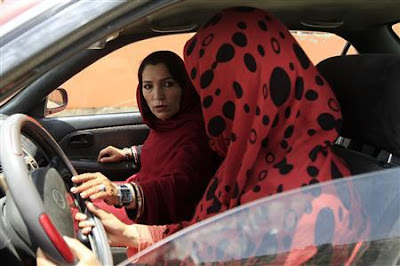
Afghan woman pushes for rights from behind the wheel
![]() |
| The morning after the Taliban fell Shakila Naderi shed her head-to-toe burqa, sat behind the wheel of a car for the first time and asked her husband to teach her how to drive. |
Now Kabul's only female driving instructor, she teaches women a rare skill that confronts harsh opposition in ultra-conservative, Muslim Afghanistan.
"It bothers men when women drive," Naderi, 45, said from behind her desk in her four-room driving school near Kabul's city centre, decorated with traffic signs and instructions in her native Dari.
"But I wasn't scared of them then and I am not scared of them now," she said, adjusting her green headscarf.
Naderi opened the school four years ago with her husband Iqbal Khan, who as a taxi driver took pity on women he saw struggling to find transportation in a country where many will not speak to men other than relatives.
Women have regained rights such as education, voting and work since the removal of the Taliban and their austere rule a decade ago, but they enjoy far less freedom than men.
Women complain of unwanted gazes and physical harassment on the cramped, crowded minibuses that are often the only method of urban public transport.
When Naderi Driving School opened, Naderi received verbal threats from the more conservative sectors of society, who decry driving as un-Islamic for women. Those have died down, she says, but male drivers often taunt her and try to chase her car off the road, sometimes causing her to swerve dangerously.
Families also bar daughters from driving, fearing it could lead them astray. Naderi's own two daughters have been prohibited by their husbands' families from learning to drive.
TAKING CONTROL OF ONE'S LIFE
A white headscarf wrapped around her wrinkled face, student Khanum Gul Obedi, 46, says she wants to take control of her life.
The mother of two teen daughters has a disabled husband and cannot afford to take taxis with fares of 300 Afghani per ride. She walks for hours around Kabul every day dropping her kids off at school and buying food.
"I never opened a book in my life besides the holy Koran, I never entered through the doors of a school," said Obedi, who is illiterate like most Afghan women.
"I got married and felt imprisoned, but now I can control things and I feel like I've been set free."
The school once mustered only one to five students for a 36-day course, a precursor to applying for a licence.
Classes now number up to 80, and some students travel from nearby provinces. In a room filled with car parts and smeared with grease, Naderi also teaches women how to deal with breakdowns.
Naderi and her husband must read out driving manuals to students in a country where more than 80 percent of women cannot read or write, an illiteracy rate double that of men.
Their work has paid off.
Kabul issued a record 312 driving licences to women last year, the traffic department said. Herat in the west and Mazar-e-Sharif in the north gave out 64 and 48 respectively to women taught mainly by other women but also by some men.
The government backs Naderi's school and has encouraged female employees to attend. But the couple's ads on billboards are often defaced or torn down.
"Boys tease me because I want to drive," said college graduate Mersal Nawabi, 21. "But I am encouraged by my brothers and father."
Student Obedi says she would never take driving lessons from a man. "This is Afghanistan. People talk and by having a woman instructor gossip is kept to a minimum".
As Naderi leaves her school and walks towards her car, a group of men nearby scream: "Hey you! We can drive too".
"I react to them as men would," she says with a grimace.
"Once I got out of my car, yelled back and slapped one so hard he bled. Then I got back into the car to teach the girls".
Subscribe to:
Posts (Atom)


